The Quick Take: Most of us spend eight hours a day answering emails, jumping on “quick calls,” and juggling 25 browser tabs—only to hit 5:00 PM feeling exhausted with zero real progress. Here is our plain-English Deep Work summary, how to separate needle-moving work from everyday busywork, and a free 1-page printable Daily Playbook you can keep on your desk.
1. The 5:00 PM Question Nobody Likes Answering
Have you ever worked hard from 9:00 AM to 5:00 PM—answering 60 emails, replying to dozens of team chat messages, sitting through four status meetings, and drinking three cups of coffee—only to look at your screen at the end of the day and think:
“Wait… what did I actually finish today?”
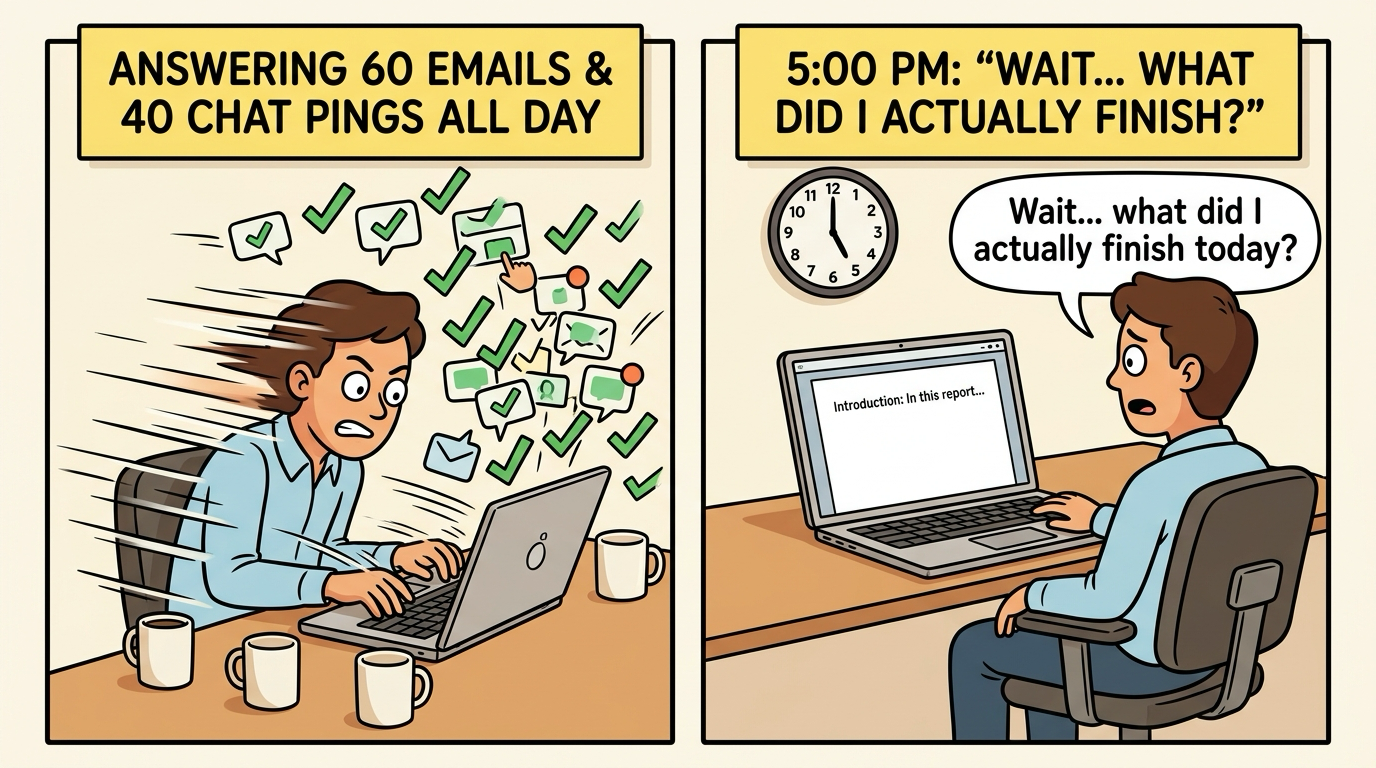
You weren’t slacking off. Your hands were moving on the keyboard all day. Yet the one big thing that actually mattered—the strategy proposal, the tricky software feature, the dense industry report you needed to digest—barely moved an inch.
When computer science professor Cal Newport wrote his book Deep Work, he put a simple name to this exact trap. And once you see the difference between the two types of work competing for your day, you can never unsee it.
2. What Is Deep Work? (Deep Work vs. Shallow Work in Plain English)
If you are looking for a quick Deep Work book summary, the entire philosophy comes down to one simple distinction: almost everything you do at your desk falls into one of two buckets.
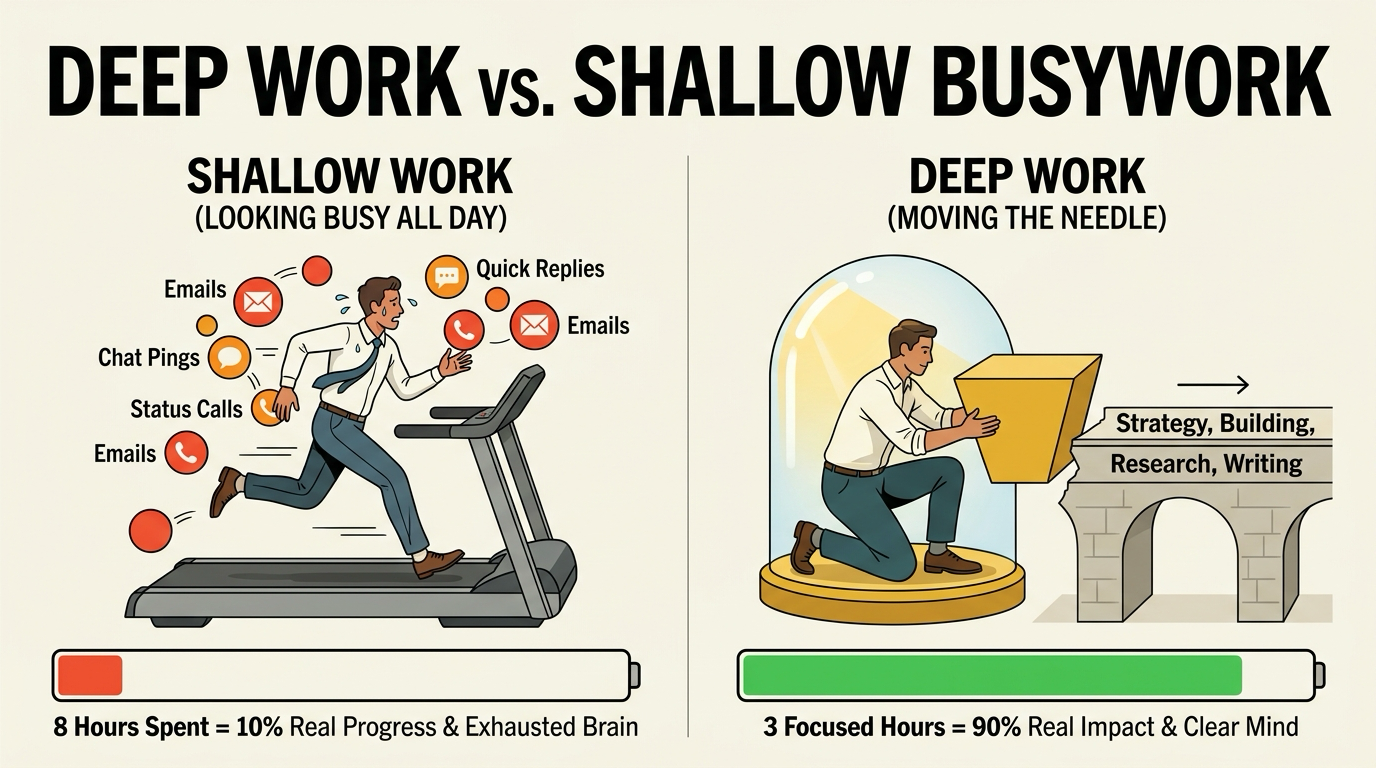
Bucket 1: Shallow Work (Looking Busy)
Shallow work is all the small, logistical busywork you can do while half-distracted:
- Replying to routine emails and “quick questions” in Slack or Teams.
- Sitting in status-update calls where five people listen to one person read a slide.
- Formatting spreadsheets, moving tickets around a board, or bouncing between 25 open browser tabs.
Shallow work feels great in the moment because checking off tiny tasks gives your brain a quick burst of relief. The problem? You can spend 40 hours a week doing shallow work and have almost nothing lasting to show for it.
Bucket 2: Deep Work (Moving the Needle)
Deep work is when you close the door, silence every notification, and give 100% of your undivided attention to one hard, valuable task:
- Writing a clear strategy document, client proposal, or research brief.
- Building or debugging a complex piece of software architecture.
- Reading a dense 50-page report or learning a difficult new skill and actually connecting the dots in your head.
Here is the secret most workplaces miss: three focused hours of Deep Work produce more real value than two full days of distracted multitasking.
3. Why Deep Work Feels Harder Today Than Ever Before
When Deep Work first came out, people mostly had to worry about email and open offices. Today, your attention is fighting a three-front war:
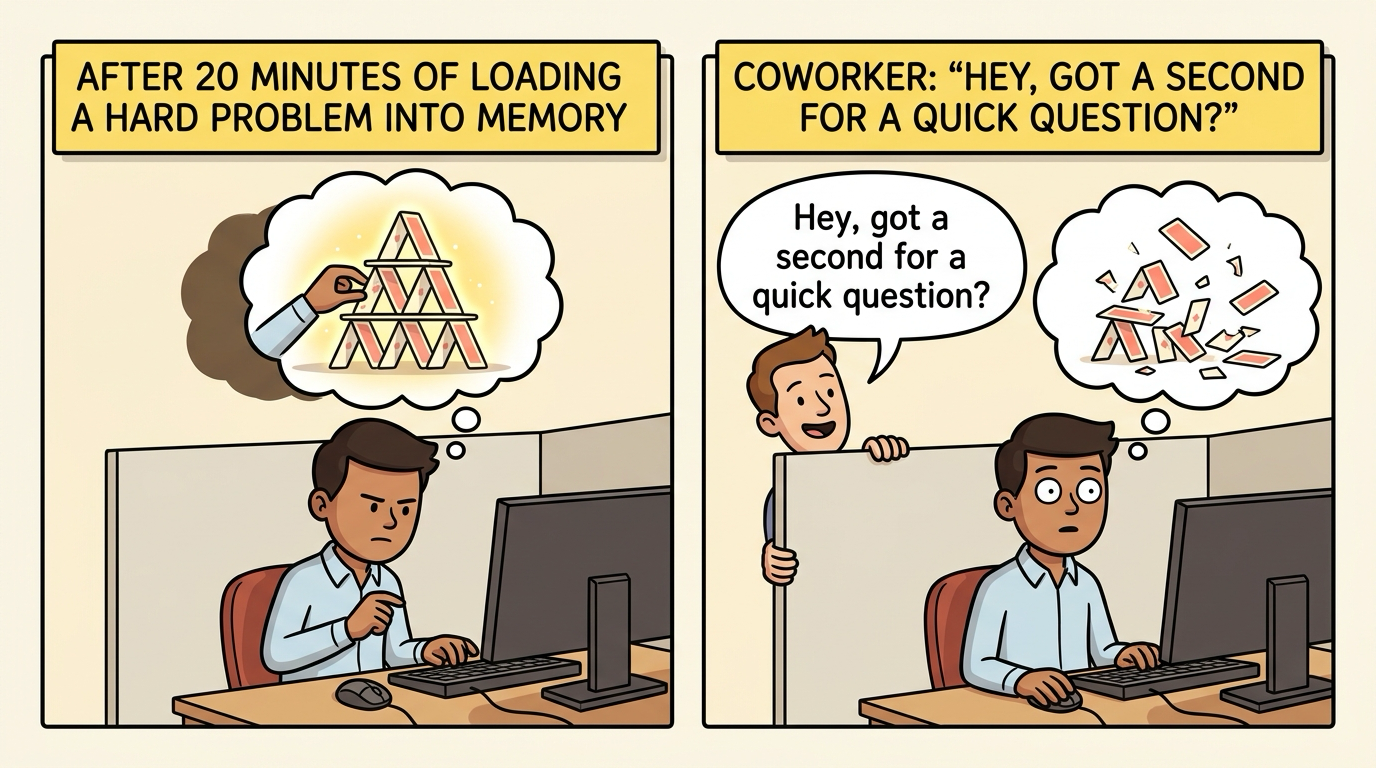
- The 20-Minute Warm-Up Tax: Whenever you work on a complex problem, it takes your brain about 15 to 20 minutes just to load all the pieces into your working memory. If a coworker pings you with “Hey, got a second?” or you take a “10-second peek” at your inbox, that mental house of cards collapses—and it takes another 20 minutes to rebuild it.
- Mental Tab Clutter: Even if you look at a message for ten seconds and don’t reply, part of your brain stays stuck thinking about that unfinished message for the next 20 minutes.
- The AI Shortcut Trap: AI tools can summarize a document or draft an email in five seconds. That speeds up shallow work—but it also tempts people to juggle five projects at once and skip the deep thinking required to actually remember and understand what they’re reading.
4. The 4 Everyday Deep Work Techniques That Actually Work
You don’t need to move to a cabin in the woods to do deep work. If you have a normal job with meetings, clients, and a team counting on you, here is the practical 4-habit summary that fits inside a real workday:
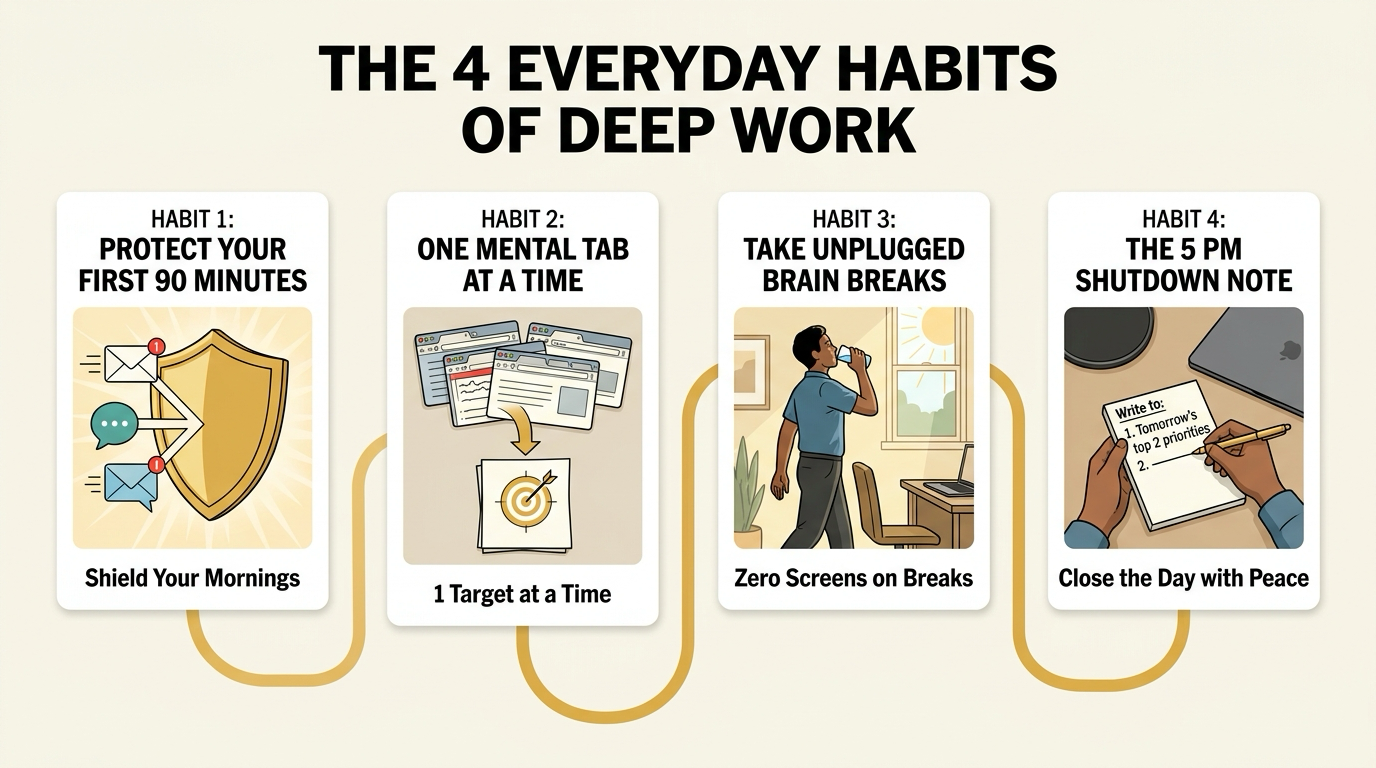
Protect Your First 90 Minutes (“Create Before You React”)
Your brain battery is at 100% first thing in the morning. If you spend your freshest hour answering yesterday’s emails, you trade your best mental energy for shallow chores. Block 60 to 90 minutes every morning (or right after your first meeting) for your #1 needle-moving project before you open your inbox.
Use the 1-Card Rule to Clear Mental Tab Clutter
Before starting a focus block, write the single outcome you want to finish on a physical index card or sticky note and set it beside your keyboard. Close the other 25 browser tabs and put your phone in another room. One card on your desk, one task on your screen.
Take True Unplugged Brain Breaks
No human brain can do heavy thinking for 8 hours straight—3 to 4 hours of deep focus per day is the natural human limit. After a 60-to-90 minute focus block, step away for 10 minutes with zero screens. Don’t trade your big work screen for your tiny phone screen; grab water, stretch, and look out a distant window so your mental scratchpad can clear.
Run a 3-Minute Shutdown List at 5:00 PM
Why do you still think about work at 9:00 PM on the couch? Because your brain is afraid you’ll forget an open loop tomorrow. Before closing your laptop at the end of the day, spend 3 minutes writing down tomorrow’s top 2 priorities on paper. Once your brain sees the plan safely parked on paper, it gives you permission to truly unplug for the evening.
5. How to Apply This to Your Role
Depending on what kind of work fills your week, here is the easiest way to start tomorrow morning:
Escaping the “All-Day Reactor” Trap
The Trap: Your calendar looks like a game of Tetris, and every 30-minute gap gets eaten by “quick email checks” that hijack your attention.
Your Move: Put one recurring 90-minute “Strategy Block” on your calendar three mornings a week. Treat it like a board meeting you cannot cancel.
Protecting Your 20-Minute Warm-Up
The Trap: Just as you finally hold the entire system architecture or draft in your head, a chat notification pops up and shatters your momentum.
Your Move: Close chat apps completely during your focus block (don’t just mute them—close the tab) and use our live Silent Sprint Room as your deep work timer.
Absorbing Dense Reports Without Brain Fog
The Trap: Reading dense industry reports, legal docs, or AI summaries for 4 hours straight and realizing two hours later that nothing stuck in memory.
Your Move: Cap heavy reading at 60–90 minutes, then close the screen and spend 10 minutes sketching the 3 main takeaways on paper from memory.
5. Free Printable 1-Page Deep Work Daily Playbook (PDF)
Many readers search for a Deep Work summary PDF they can print out and keep next to their keyboard as a daily reminder. Because we respect copyright, we don’t distribute copies of the book—instead, we designed our own original 1-Page Printable Deep Work Daily Playbook & Desk Checklist summarizing the 4 habits and daily desk checklist on a single clean sheet.
Enter your email below and we’ll send the high-resolution printable 1-Page Playbook straight to your inbox:
Get the 1-Page Printable Deep Work Daily Playbook
Keep the Deep vs. Shallow Work Filter, the 4 Daily Focus Rules, and the 6-Point Morning & 5 PM Shutdown Checklist right next to your keyboard.
6. Frequently Asked Questions
What is the main message of Deep Work in one sentence?
The core message is that 3 to 4 hours of uninterrupted, single-task focus on your most important problem produces far more valuable work—and leaves you far less burned out—than 8+ hours of distracted multitasking across emails, chats, and tabs.
How many hours of deep work can a person realistically do per day?
Research and real-world practice show that 3 to 4 hours per day is the upper limit for intense, focused thinking. Beyond four hours, your mental battery runs low and mistakes multiply. If you get two solid 90-minute focus blocks done, you have won the day.
How do I do deep work if my job requires me to answer messages quickly?
You don’t need to disappear for the whole day. Tell your team: “I’m heads-down working on [Project X] from 9:00 to 10:30 AM and will check messages right at 10:30.” Almost every workplace respects a 90-minute focus window when people know exactly when you’ll be back online.
🎁 Next Step: Find Out Where Your Focus Is Leaking
Want to see which daily habit is draining your mental battery the fastest—and get a custom routine tailored to your exact workday?
- 👉 Take the Free 2-Minute Focus Diagnostic Quiz to get your personalized Focus Score and daily action plan.
- 👉 Try a Live Focus Block in the Sprint Room when you need a quiet, distraction-free deep work timer to lock in and finish your hardest task today.