
The Quick Take: Have you ever caught yourself reading the exact same sentence on your screen three times without absorbing a single word? When your brain freezes in the middle of the workday, sitting there and trying to force yourself to work harder only drains your battery faster. Here is a simple, 3-minute physical reset to clear the fog and get moving again—without needing superhuman willpower.
It’s 1:45 PM on a Wednesday.
You have an important document open in front of you. You know it needs to get done today. You aren’t even actively procrastinating—you’re sitting right there in your chair, hands on the keyboard, staring straight at the monitor.
And yet, nothing is happening.
You read the same paragraph three times, and the words just bounce off your eyes. You click over to another tab, forget why you opened it, and click right back. A quiet wave of frustration builds in your chest: Why can’t I focus on work right now? What is wrong with me today?
First, let’s clear one thing up right away: nothing is wrong with you.
When your mind stalls out at your desk, it isn’t because you suddenly became lazy or lost your ambition. It happens because your brain has quietly hit a physical bottleneck—and the way most of us try to fix it accidentally makes the freeze twice as bad.
1. Why “Pushing Through” Backfires (The Overheated Engine)
What is the very first thing most of us do when we realize we can’t focus on work?
We tense our shoulders, lean closer to the monitor, pour another cup of coffee, and tell ourselves: “Come on, just buckle down and finish this.”
Think of your brain like a car engine stuck in thick mud. When the tires are spinning and going nowhere, slamming your foot harder on the gas pedal doesn’t get you out of the mud. It just overheats the engine and burns through your remaining fuel.
When you sit at your desk feeling behind on a deadline, your body quietly flips on a low-level stress alarm. Your breathing gets shallow, your vision narrows down to a 15-inch glowing rectangle, and your working memory—the mental scratchpad you use to hold ideas together—shrinks.
Trying to do thoughtful, creative work while your brain is in that state is like trying to do math in your head while someone is honking a car horn next to your ear. You don’t need more discipline; you need to turn off the horn.
2. The “Fake Break” Trap: Why Grabbing Your Phone Makes You More Tired
When pushing through doesn’t work, most of us swing to the other option: “Okay, I’ll just take a quick 5-minute break.”
So you reach for your phone, open your inbox, check a news site, or scroll through a social feed.
Have you ever noticed that when you put your phone down 10 minutes later and look back at your work screen, your brain feels even heavier and foggier than before?
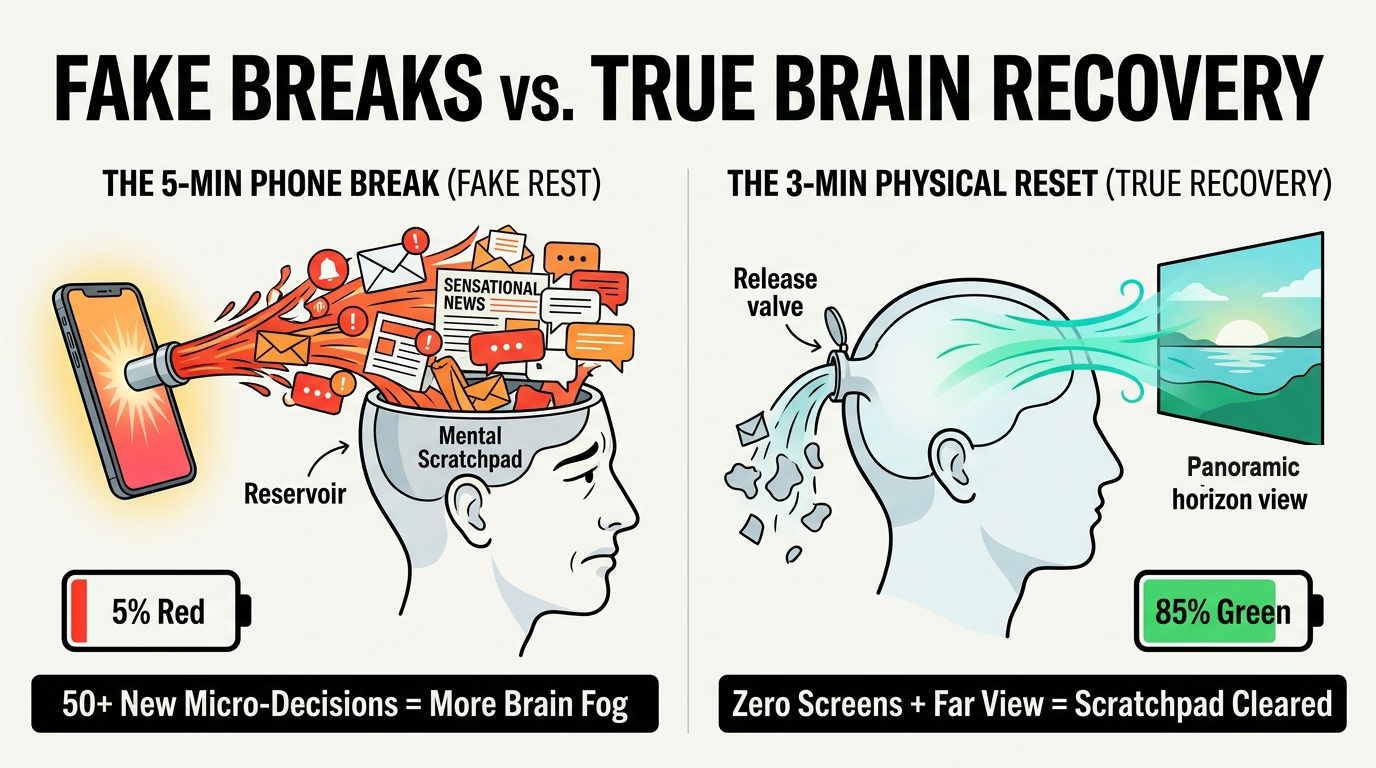
That happens because scrolling on a phone isn’t a break for your brain—it’s just changing the channel to a faster, louder kind of work.
Every headline, message, or short video you scroll past forces your brain to process new information, feel a tiny spike of emotion, and make micro-decisions. Instead of letting your mental scratchpad wipe clean, a phone break piles 50 new sticky notes on top of it.
To actually clear brain fog, your eyes and your working memory need three minutes of zero new input.
3. The 3-Minute Desk Reset (Step-by-Step)
Next time you catch yourself staring blankly at your screen unable to start, stop typing immediately. Don’t open a new tab, and don’t touch your phone.
Instead, run this exact 3-minute physical sequence right at your workspace:
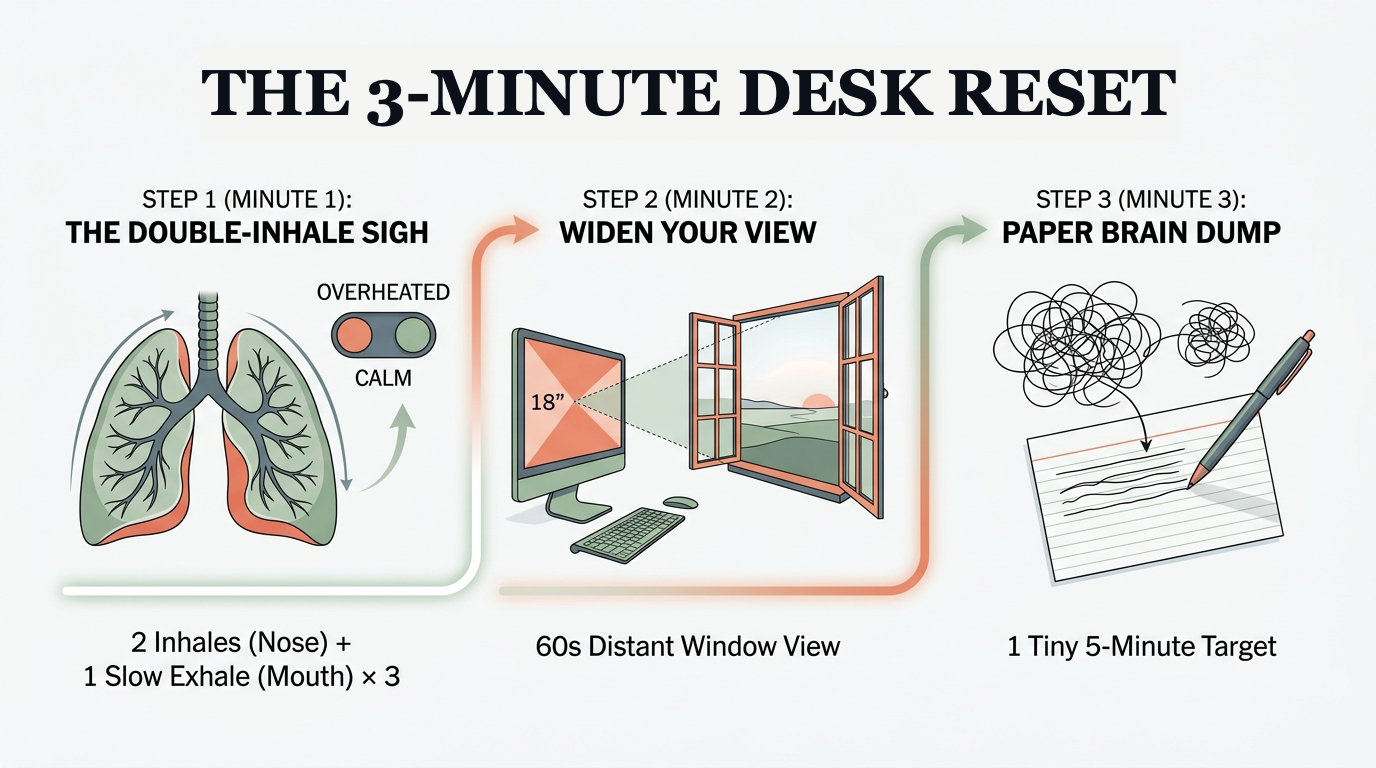
Minute 1: The Double-Inhale Sigh (Turn Off the Stress Alarm)
When we stare at screens and emails, we unconsciously hold our breath or breathe very shallowly—sometimes called “screen apnea.” That shallow breathing tells your nervous system that you’re under threat.
Researchers at Stanford Medicine tested dozens of ways to calm the brain down in real time and found that the fastest natural switch is a simple breathing pattern called the Physiologic Sigh:
- Push your chair back slightly and drop your shoulders away from your ears.
- Take a deep inhale through your nose, and right at the top, take one more quick little “top-off” sniff through your nose to completely fill your lungs.
- Let all the air out in a long, slow, unhurried exhale through your mouth (make the exhale twice as long as the inhale).
- Repeat this just 3 times.
Within 45 seconds, your heart rate slows down and that tight, restless feeling in your chest noticeably fades.
Minute 2: Widen Your View (Break the Tunnel Vision)
Your eyes and your stress levels are wired directly together. When you focus tightly on a glowing screen 18 inches from your face for hours at a time, your brain stays locked in high-alert tunnel vision.
For the second minute, stand up and look out a window, down a long hallway, or across a courtyard. Let your eyes focus on the farthest point you can see—trees, buildings, or the horizon—and let your gaze soften into a wide, panoramic view for 60 full seconds.
Giving your eyes distance immediately signals to your brain that it can relax its grip.
Minute 3: The Paper Brain Dump (Clear Your Mental RAM)
Often, the real reason you can’t focus on work isn’t the task in front of you—it’s the seven other unfinished things bouncing around in the back of your head (“I need to reply to Sarah, pay that bill, fix that other slide, check on that package…”).
Grab a physical scrap of paper or an index card (not a digital app) and do a 60-second Parking Lot Dump:
- Write down every nagging errand, reply, or side-task that is competing for your attention right now.
- Tell yourself: “These are safely parked on paper. I don’t need to hold them in my head for the next hour.”
- Flip the paper over, and write down one tiny, physical action to restart your main task.
4. How to Restart Without Overwhelm: The “5-Minute Entry Ramp”
Once you sit back down after your 3-minute reset, there is still one trap left: looking at a massive, complicated project and feeling that wave of dread return.
When your battery is low, your brain will always resist a vague, giant goal like “Finish the Q3 client strategy deck” or “Refactor the payment module.” That feels like climbing a mountain.
Instead, use the 5-Minute Entry Ramp:
- Shrink the target until it feels almost laughably small: Don’t try to write the whole report; just write three messy bullet points for Section 1. Don’t try to fix the whole bug; just open the file and read the first function.
- Give yourself permission to stop after 5 minutes: Tell yourself, “I only have to do this one tiny step for 5 quiet minutes. If I still want to stop after 5 minutes, I can.”
Almost every single time, the hardest part was simply crossing the starting line. Once your hands are moving on one small, clear target with zero competing tabs open, momentum takes over naturally.
5. Frequently Asked Questions
Why can’t I focus on work even when I have an urgent deadline?
When a deadline feels overwhelming, your brain can tip from helpful alertness into freeze mode. Instead of helping you move faster, that spike of pressure floods your working memory with worry. Running a 3-minute physical reset (slow exhales + shrinking the task to a 5-minute step) lowers the pressure enough for your thinking brain to come back online.
Does drinking more coffee help when I can’t focus at work?
Usually, no—especially in the afternoon. If your inability to focus comes from mental clutter or stress rather than lack of sleep, extra caffeine just adds jittery speed to an already scattered mind. A glass of water and 60 seconds of fresh air will clear afternoon brain fog far better than a third espresso.
What should I do if I reset my desk and still can’t get started?
Stop trying to work alone in an empty room. Human brains are wired to mirror the people around them—which is why it’s so much easier to focus in a quiet library or coffee shop. Stepping into a silent virtual coworking session alongside other focused people creates gentle, instant momentum without needing willpower.
Next Step: Stop Fighting Your Focus Alone
If you’re tired of spending your afternoons staring at a blinking cursor and battling mental tab clutter, let’s find out what’s actually draining your focus battery.
Take our free, 60-second assessment to pinpoint your exact focus bottleneck:
👉 Take the 60-Second Focus Habit Assessment
You’ll get your personalized Focus Dossier plus a complimentary 1-Time Guest Pass to our Hourly Focus Sprint Room (`thedeepworkhub.com/guest-pass`)—where you can lock in one target and work in calm, 50/10 parallel silence alongside builders from around the world.