The Quick Take: Have you ever wondered why you feel exhausted at 3:00 PM without having touched the one project that actually matters? You’re not lazy, and you don’t lack willpower. Your work environment was accidentally designed to drain your mental battery. Here is the friendly, realistic 4-step rhythm to reclaim uninterrupted focus without the burnout.
It’s 2:15 PM on a Tuesday.
You’re sitting at your desk with a cup of coffee you poured hours ago and barely had time to touch. You have 28 browser tabs open. Your Slack or Teams icon has three little red notification badges. In eight minutes, a calendar alert is going to pop up reminding you of a “quick 15-minute sync.”
You look down at your screen and realize: I’ve been working all day, but I haven’t actually accomplished the one thing I needed to do.
If this sounds familiar, take a deep breath.
This isn’t a character flaw. You didn’t suddenly lose your discipline or work ethic. What you’re experiencing is the natural reaction of a human brain trying to do creative, thoughtful work inside an environment that treats you like an assembly line machine.
1. Why “Just Trying Harder” Never Works
Have you ever noticed that the harder you try to force yourself to concentrate when you’re tired, the more your hand automatically drifts toward your phone or opens a new tab?
Think of your attention like your phone’s battery.
When you start your morning with a full charge, your brain has plenty of power to make tough decisions, solve complex problems, and resist the temptation of checking your inbox. But every little decision—every ping, every switch between apps, every “Hey, do you have a quick second?”—leaves an app running in the background.
By 1:30 PM, your battery is at 8%, and your phone goes into low-power mode.
The old-school 8-hour workday was invented a century ago for factory workers bolting car doors on an assembly line. If you assemble parts for eight hours, you produce twice as much as someone working four hours.
Modern desk work doesn’t work that way. When your brain battery is empty, sitting at your desk for four more hours doesn’t produce good work—it just produces exhaustion and frustration.
2. The “Mental Tab Clutter” Trap: Why One Quick Peek Derails Your Entire Afternoon
Why does glancing at an email for 30 seconds throw you off track for the next half hour?
Here is what actually happens: when you’re writing a report or coding a feature (Task A), and you quickly flip over to answer a Slack message (Task B), your brain doesn’t just cleanly teleport between them.
A piece of your attention stays stuck to that message. Did that person sound annoyed? What do they need next? Did I phrase that reply correctly?
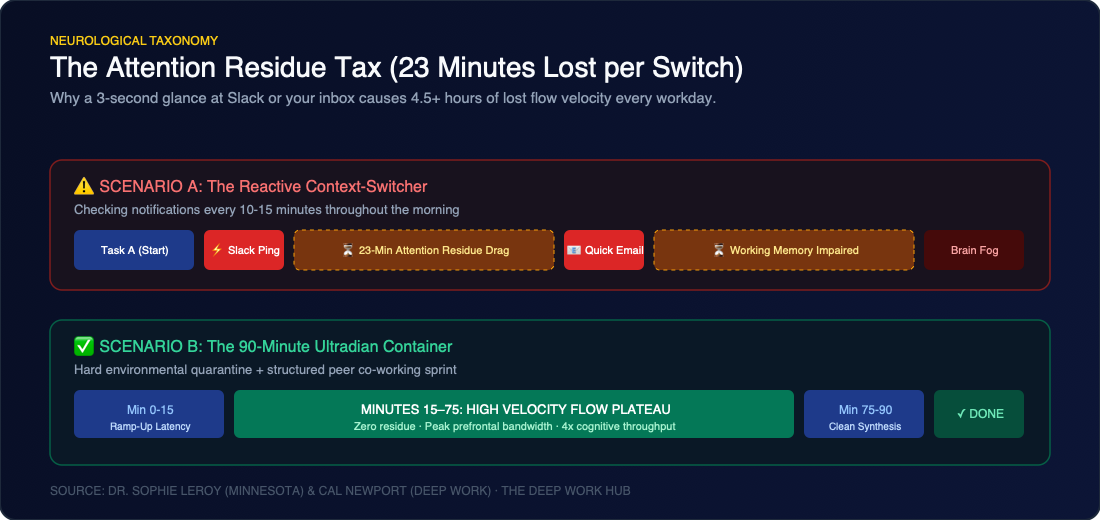
Researchers call this “attention residue”—but you can just think of it as Mental Tab Clutter.
Even after you click back to your report, half your working memory is still trying to close that other tab. If you check messages every 15 minutes, your brain never gets a chance to reach a smooth, effortless rhythm. You spend your entire day running in first gear.
3. The 4-Step Focus Rhythm You Can Start Tomorrow
So how do you get your focus back without having to move into a cabin in the woods or quit your job?
You don’t need complicated productivity apps or militant discipline. You just need to work with your natural energy waves instead of fighting them.
Here is the 4-step daily rhythm that changes the game:
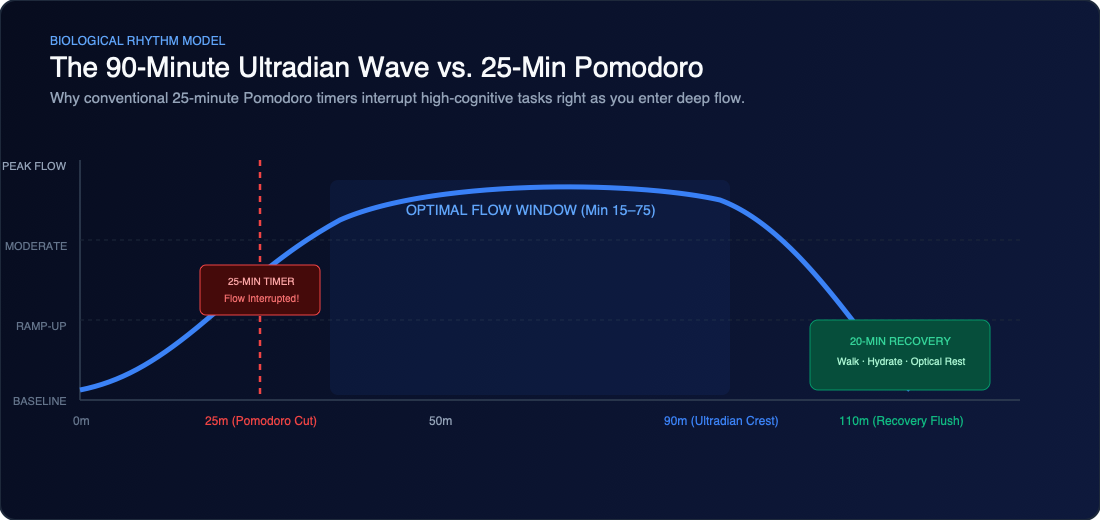
Ride Your 90-Minute Wave (Instead of the 25-Minute Alarm)
Have you ever tried the popular 25-minute Pomodoro timer, only to feel irritated when the bell rings right as you were finally getting into the groove? That’s normal. Your brain takes about 15 minutes just to warm up. Give yourself a 60-to-90 minute container so you actually have room to do meaningful work without a buzzer cutting you off.
Build a 5-Minute “Quiet Bubble” Before You Start
You don’t need willpower if you put friction between you and your distractions. Before starting your focus block, full-screen your document or IDE, close your email tab, and put your smartphone completely out of arm’s reach (even in another room). When checking your phone requires standing up from your chair, your brain stops craving the distraction.
Take a Real Brain Break (The “No Screen” Rule)
When your 90 minutes are up, resist the urge to immediately scroll Instagram or check the news. That isn’t a break—that’s just feeding your brain a different flavor of noise. Stand up, stretch, grab a glass of water, or step outside and look at the sky for 10 minutes. Giving your eyes and mind a rest recharges your battery in a fraction of the time.
Work Alongside Someone (Silent Coworking)
Have you ever noticed that you get way more work done sitting in a quiet library or coffee shop where everyone else is working? That’s human nature. Working silently alongside peers—whether a colleague or in a camera-optional virtual sprint room—creates gentle, positive accountability that keeps you anchored.
4. How to Adapt This for Your Daily Work Life
Everyone’s workday looks a little different. Here is how to apply this rhythm depending on your role:
Escaping the Slack Ping Vortex
The Reality: High ramp-up time. A single notification destroys the complex mental map you just spent 40 minutes building.
The Fix: Block two 90-minute “Do Not Disturb” slots on your calendar (e.g., 9:30–11:00 AM and 2:00–3:30 PM). Close messaging apps during those blocks. True emergencies are rare; everything else can wait 90 minutes.
Surviving Calendar Tetris
The Reality: 30-minute swiss cheese gaps between meetings where you can’t focus on anything substantial.
The Fix: The Pre-Meeting Morning Shield. Protect the first 45 minutes of your morning before your first call for big-picture thinking before your brain gets pulled into reactive mode.
The “Too Many Hats” Paralysis
The Struggle: Trying to handle client work, invoicing, marketing, and sales all on the same day, ending up overwhelmed.
The Fix: The 2-Task Rule. Every evening, write down the exact two needle-moving tasks for tomorrow morning. Do not open email until both are completed.
Ditching the Passive Rereading Trap
The Struggle: Staring at textbooks or lecture slides for 4 hours and feeling like nothing is sticking.
The Fix: Close the notes. Spend 20 minutes sketching what you actually remember on a blank piece of paper. If you can explain it to a friend, you know it.
5. Frequently Asked Questions (The Honest Answers)
How many hours of intense focus can a person realistically do in a day?
Most people max out at 3 to 4 hours of genuine, high-depth focus per day. That’s not laziness—that’s biology. Trying to force 7 or 8 hours of deep concentration only leads to diminishing returns and typing while exhausted.
Why does the 25-minute Pomodoro technique make me feel anxious?
The 25/5 Pomodoro method was originally created for quick study tasks. For complex problem-solving (like writing or coding), 25 minutes cuts you off right when your brain is warming up. A 50-to-90 minute container gives you the ramp-up time complex tasks actually require.
What should I do during breaks to truly reset my brain?
Pick low-stimulation activities: take a walk, stretch, drink water, or do simple breathing exercises. The golden rule is: leave your phone alone. Checking your notifications fills your brain with fresh mental clutter right when it needs to rest.
Next Step: Where Is Your Focus Leaking?
Focus fatigue isn’t one-size-fits-all. Some people get derailed by notification pings; others get caught in meeting marathons or struggle to start in the morning.
Take our free, 60-second assessment to pinpoint your exact focus bottleneck:
👉 Take the 60-Second Focus Habit Assessment
Get your personalized Focus Dossier and an instant guest pass to our Hourly Virtual Sprint Rooms to experience what uninterrupted work actually feels like.
