The Quick Take: Searching for the best music to focus on work usually leads to a 4-hour curated lo-fi or movie soundtrack playlist. But forty minutes later, you find yourself skipping tracks, adjusting volume, or singing along in your head instead of finishing your project. Here is why conventional playlists secretly hijack your working memory—and how 5 targeted acoustic chambers turn sound into a neurochemical shield for effortless flow.
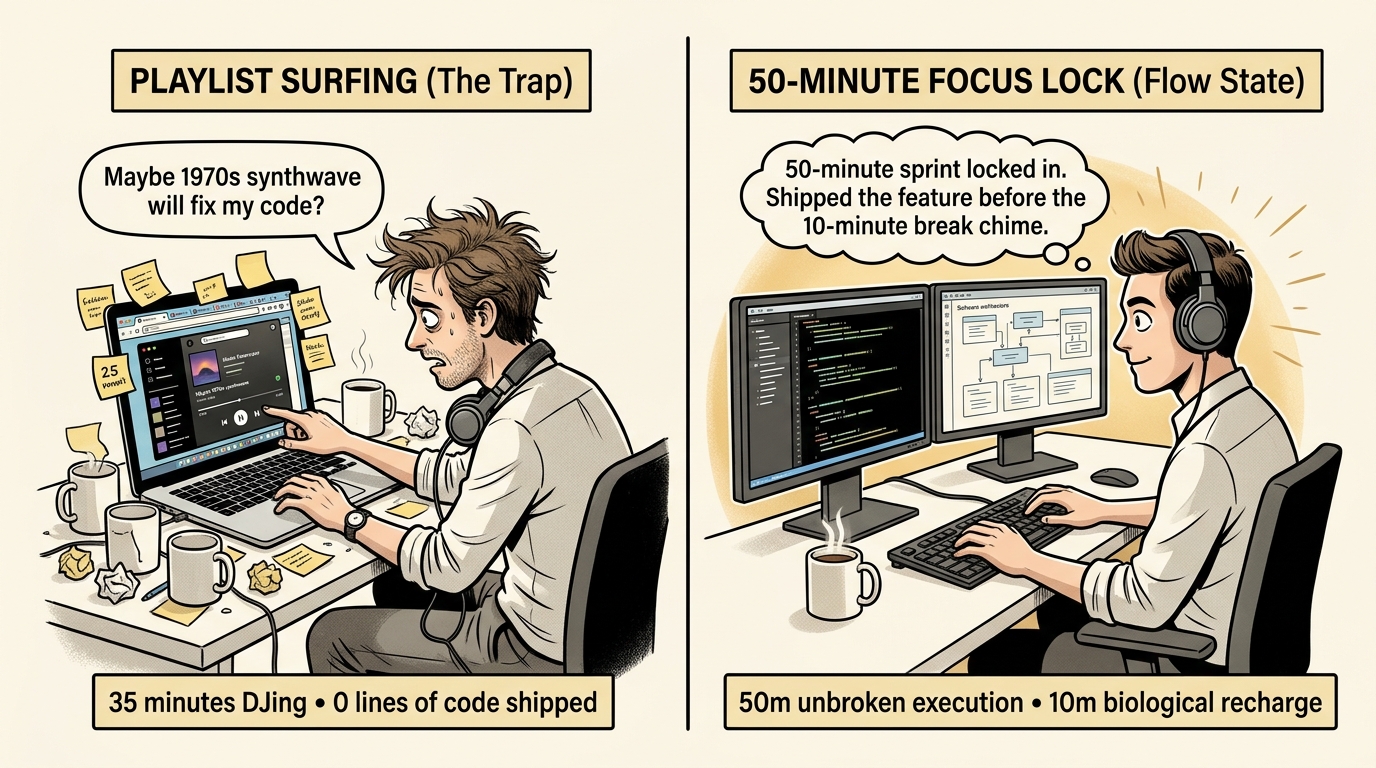
1. The 11:15 AM “Playlist Surfing” Trap
Picture this:
It’s 10:45 AM. You have a complex specification to draft, a stubborn bug to trace, or an analytical model to build before your 1:00 PM check-in. You sit down with a hot coffee, open your IDE or document editor, put on your noise-canceling headphones, and open Spotify or YouTube.
You type: “deep focus study music” or “synthwave for coding.”
Track 1 starts: a mellow, ambient synth pad. Your shoulders drop. You type the first two paragraphs. Everything feels under control.
Then Track 2 arrives. It introduces a faint vocal chop or an unexpected tempo acceleration. Your subconscious auditory cortex perks up: Who is that singing? What key did that shift to?
Before you realize it, you’ve alt-tabbed over to your streaming app to hit Skip.
Track 3 is too slow—it feels like an elevator in a dentist’s office. You hit Skip again.
Track 4 is a film score you love, but suddenly you are picturing Hans Zimmer’s spinning docking sequence from Interstellar instead of reviewing your database schema.
By 11:15 AM, you have spent 25 minutes acting as your own unpaid radio DJ. You haven’t entered a flow state. You’ve just experienced acoustic cognitive drag.
2. The Neuroscience of Acoustic Drag: Why Your Brain Hates “Pretty” Songs
When people search for music to focus on work, they usually look for music they enjoy. And that is the exact mistake that sabotages their concentration.
Your brain’s working memory is physically constrained. As cognitive neuroscientists and researchers like Dr. Andrew Huberman have documented, auditory processing occupies significant neural bandwidth.
Every sound entering your ears is routed through your thalamus and auditory cortex, where your brain runs three silent tests:
- Vocal Threat & Semantic Decoding: If a track contains human vocals—or even chopped vocal-like synthesizers—your language processing centers (Broca’s and Wernicke’s areas) involuntarily fire up to decode the words. Even if you aren’t consciously listening, your brain is burning glucose trying to understand the message.
- Tempo & Melodic Expectancy: Western melodic music is built on tension and resolution (chord progressions like I-V-vi-IV). When you hear a chord, your brain predicts the next note. When the melody resolves, you get a micro-hit of dopamine; when it delays, you experience mild neurological tension. This emotional rollercoaster is wonderful for a Saturday drive, but it’s catastrophic when you need 100% of your prefrontal cortex focused on complex problem-solving.
- Dynamic Volume Spikes: The crescendo in a movie soundtrack triggers your startle reflex and pulls you out of a theta-alpha flow state back into beta vigilance.
Key Rule: The best focus soundscape is not entertainment. It is an acoustic sensory shield that eliminates external conversational chatter while providing predictable, rhythmic neural entrainment.
Why Generic YouTube Binaural Beats Fail: The Habituation Trap
Many ambitious professionals try downloading free “binaural beats” on YouTube. But after 20 minutes, they find themselves irritated, fatigued, or pulling off their headphones.
Why? Because YouTube binaural tracks are usually raw, static mathematical sine waves. Without dynamic multi-band envelope modulation, your brain’s reticular activating system quickly experiences auditory habituation—it flags the monotonous hum as sensory irritation. Real cognitive phase-locking requires dynamic, living acoustic layers that adapt gently to keep your focus locked without causing neurological fatigue.
3. The 5 Foundational Acoustic Chambers (And When to Deploy Each)
At The Deep Work Hub, we don’t treat audio as background wallpaper. We treat it as an engineered acoustic chamber calibrated to your cognitive task.
Rather than exposing raw frequencies that invite habituation, our audio engine operates through five foundational chamber archetypes. Each archetype houses an expanding catalog of curated soundscapes engineered for specific work modes:
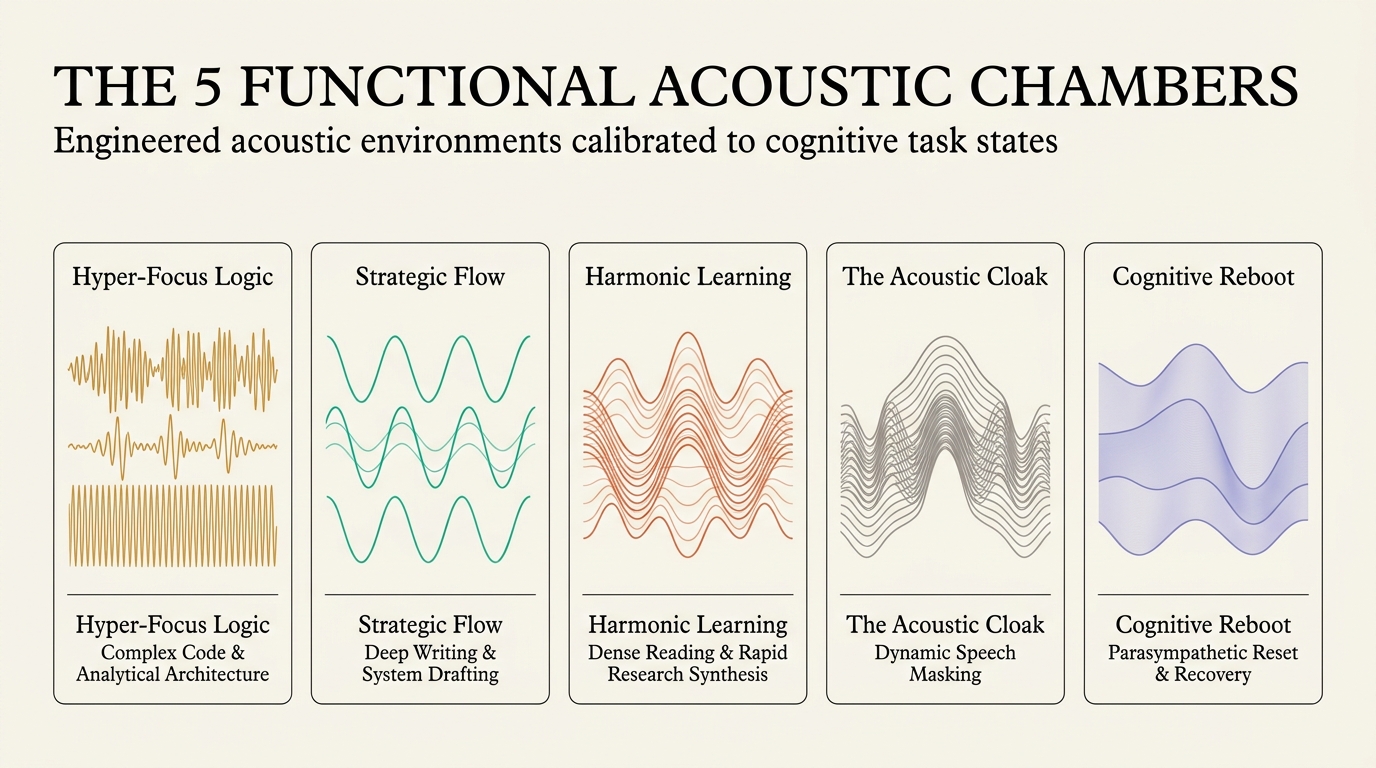
Chamber 1: Hyper-Focus Logic (Complex Code & Non-Linear Thinking)
- The Cognitive State: Synchronized neural firing across distant cortical regions. Required when mathematicians, senior software engineers, and system architects tackle dense, non-linear abstractions.
- Proprietary Acoustic Mechanism: Deep Neural Phase-Locking embedded within low-frequency ambient stabilization drones. Eliminates internal mental chatter and anchors unbroken logic streams.
- Best Used For: Writing compiler code, refactoring microservices, debugging complex financial ledgers, or tracing distributed system bugs.
Chamber 2: Strategic Flow (Deep Writing & Architecture)
- The Cognitive State: Relaxed alertness—the bridge between conscious execution and intuitive synthesis. Your critical internal inner-editor is quieted, allowing words and structural frameworks to flow smoothly.
- Proprietary Acoustic Mechanism: Synchronized Rhythmic Entrainment featuring undulating atmospheric textures and subtle harmonic pacing.
- Best Used For: Drafting articles, outlining product roadmaps, creative copywriting, and high-level strategy whitepapers.
Chamber 3: Harmonic Learning (Dense Reading & Synthesis)
- The Cognitive State: High-receptive knowledge absorption without cognitive saturation.
- Proprietary Acoustic Mechanism: Natural Acoustic Resonance and organic harmonic overtones that reduce subjective ear fatigue during multi-hour study sessions.
- Best Used For: Dense textbook studying, academic paper synthesis, technical documentation reviews, and legal brief analysis.
Chamber 4: The Acoustic Cloak (Dynamic Speech Masking)
- The Cognitive State: Absolute sensory isolation in hostile or unpredictable environments.
- Proprietary Acoustic Mechanism: Dynamic Speech-Band Masking with steep acoustic attenuation (dropping 6 dB per octave). Deep, low-end sound saturation that completely obliterates intelligible human speech (300 Hz – 3,000 Hz).
- Best Used For: Working in crowded coffee shops, busy open-plan offices, or noisy home environments with family or street noise outside.
Chamber 5: Cognitive Reboot (Post-Sprint Nervous System Reset)
- The Cognitive State: Deep parasympathetic recovery. High-focus deep work depletes acetylcholine and dopamine. Jumping straight from intense logic into social media scrolling keeps your nervous system trapped in sympathetic stress.
- Proprietary Acoustic Mechanism: Expansive Restorative Soundscapes designed to lower heart rate variability, trigger the parasympathetic response, and facilitate a 3-minute physical breathing reset.
- Best Used For: The mandatory 10-minute biological buffer between 50-minute sprints.
4. The Virtual Sprint Room Protocol: The 50/10 Focus Engine
Great acoustics are useless if you have to manually configure them every time you sit down. Decision fatigue before you even start working is the #1 killer of momentum.
That is why we built the Focus Lock Protocol inside our Virtual Sprint Room:
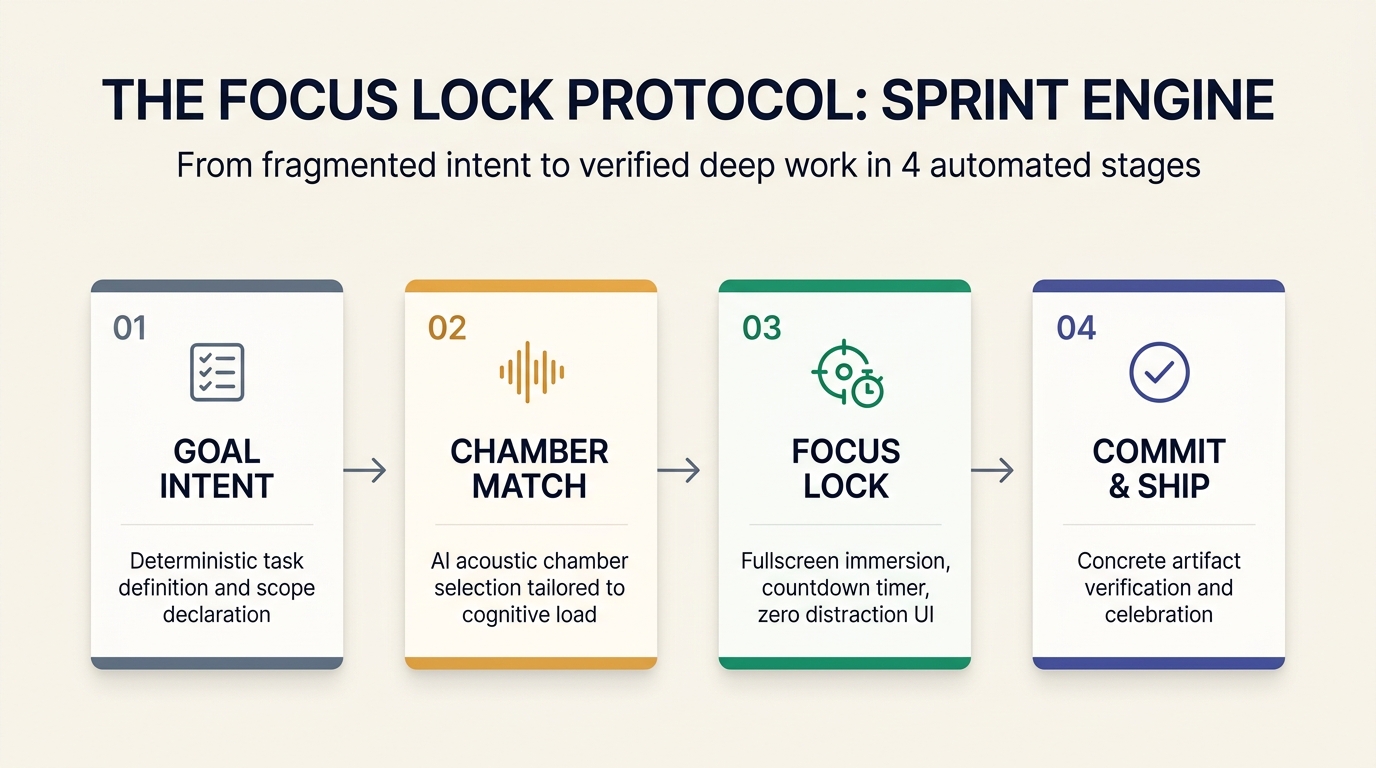
Here is how the automated 50/10 workflow operates:
- Deterministic Goal Intent: You declare a single, tangible deliverable (e.g., “Finish Section 3 of Article 5”).
- Automated Chamber Match: Our system detects whether your sprint requires heavy analytical logic, expansive writing, or intense speech masking, instantly cueing the exact functional acoustic chamber for you.
- Acoustic Focus Lock (50 Minutes): The screen enters a distraction-free, full-canvas environment. No playlist controls. No song skipping. Just seamless, uninterrupted acoustic immersion synced to your 50-minute countdown.
- Verified Output Commit (10-Minute Recharge): At minute 50, your soundscape gracefully transitions to a soothing completion chime, prompting you to commit your completed artifact and enter the 10-minute biological recharge window.
5. Summary Comparison: What to Listen to When
| Cognitive Work Mode | Chamber Archetype | How It Drives Focus |
|---|---|---|
| Complex Logic & Code | Hyper-Focus Logic | Neural phase-locking synchronizes cortical firing with zero melodic intrusion. |
| Writing & Strategy | Strategic Flow | Synchronized entrainment quiets the internal editor and unlocks fluid drafting. |
| Dense Reading & Research | Harmonic Learning | Natural acoustic overtone resonance prevents cognitive and auditory fatigue. |
| Loud Office & Busy Cafes | The Acoustic Cloak | Dynamic speech-band masking completely blankets intelligible conversations. |
| Post-Sprint Recovery | Cognitive Reboot | Parasympathetic restorative tones lower cortisol and reset mental bandwidth. |
🚀 Experience Acoustic Focus Lock in Action
Stop fighting playlist algorithms and ambient office chatter alone. Step into our browser-based Virtual Sprint Room where the acoustic focus engine and 50/10 protocol run automatically.
⏱️ Try the Hourly Focus Sprint Room (Complimentary VIP Pass)
Experience the Hyper-Focus Logic chamber and automated 50/10 focus lock with zero setup or playlist management.
- ✅ Instant browser access—no downloads, plugins, or software to install
- ✅ Automated acoustic chamber selection matched to your goal intent
- ✅ 50 minutes of continuous focus lock followed by a 10-minute restorative chime
- ✅ Silent parallel accountability alongside builders and professionals worldwide
Looking for more practical focus protocols? Explore our companion guide on How to Stay Focused at Work: The 3-Hour Golden Window or test our 3-Minute Mental Reset before your next sprint.